By
By: A Pointed View | August 24, 2026
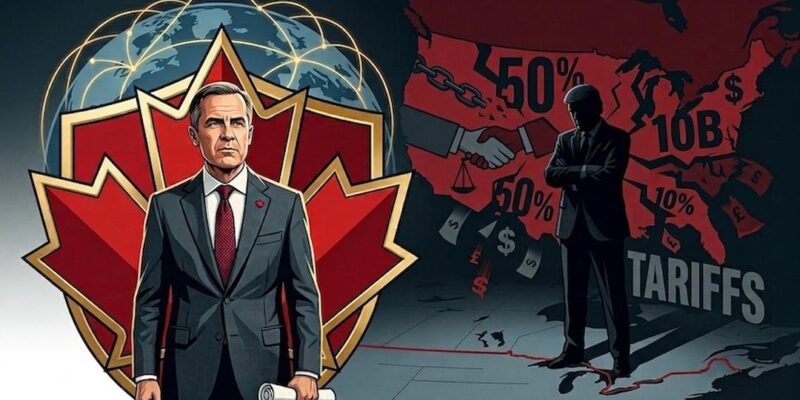
Mark Carney remains composed.
That composure reflects both the discipline of a leader who has headed the Bank of Canada and the Bank of England, and the judgment of someone who understands the psychology of markets, crises and public confidence. But composure is not indifference, and restraint must never be mistaken for weakness or retreat.
Carney’s decisive actions—and his calm but pointed criticism of Washington’s negotiating conduct—make clear that Canada is confronting far more than another dispute over tariffs. This is a direct test of the country’s economic foundations, sovereign decision-making and national security.
Carney may not raise his voice, but his position is already clear:
Canada is prepared to negotiate, but it will not submit. It is prepared to cooperate, but never at the expense of its sovereignty or long-term national interests.
This is not only the most serious challenge Carney has faced since becoming prime minister. It is also the most consequential test of his public service career to date.
THIS IS NO ORDINARY TRADE DISPUTE
Canada did not initiate this trade war, but it must now bear its potentially severe consequences.
Tariffs may appear to be little more than percentages on a customs schedule. In the real economy, however, they can mean shuttered factories, lost orders, investment deferred or diverted, disappearing jobs and higher costs for Canadian families.
When a powerful country uses the weight of its market and the reach of its trade policy to force concessions from a neighbour—or to restrict that neighbour’s freedom to determine its own industrial, energy, agricultural and national-security policies—tariffs cease to be merely economic instruments. They become weapons of political pressure and economic coercion.
Canada is therefore defending far more than steel, aluminum, automobiles, softwood lumber or access to the American market. It is defending its right to make sovereign decisions, protect its people and determine its own economic future.
National sovereignty is not for sale, and national dignity cannot be traded for a handful of tariff concessions.
PARTNERSHIP MUST NEVER BECOME SUBORDINATION
Canada and the United States share the world’s longest international border. Their energy systems, investment flows, manufacturing sectors and supply chains are deeply integrated. Whatever the political climate, neither country can—or should—seek to sever that relationship.
Ultimately, Canada and the United States will need to return to the negotiating table and restore a stable, predictable and functional economic relationship.
But Canada must recognize a fundamental truth:
Partnership is not dependence. Friendship cannot demand submission. Economic integration must never give a foreign government a veto over Canada’s sovereign choices.
If Washington can repeatedly impose deadlines, expand its demands and threaten tariffs until Canada yields, then today’s dispute over steel, aluminum and automobiles could become tomorrow’s confrontation over energy, critical minerals, agriculture, defence procurement—or even Canada’s freedom to choose its own international partners.
The greatest danger is not the 50 per cent tariff alone. It is what this crisis has suddenly exposed: Canada has allowed too much of its economic lifeblood to depend on a single market.
That dependence has become so profound that another government need only brandish the threat of tariffs to unsettle Canadian businesses, workers, public finances and politics.
This is not the position Canada should occupy—and it must never become a condition Canada is forced to accept as normal.
RESTRAINT MUST BECOME NATIONAL ACTION
Carney’s composure is commendable, but composure alone cannot resolve this crisis. Resolve that is not translated into action will remain little more than posture.
Canada does not need retaliation driven by anger. It needs a response that is firm, proportionate, precisely targeted and strategically effective. The objective should not be vengeance or the indefinite prolongation of conflict. It should be to make clear to Washington that economic coercion carries consequences—and that Canada will not surrender its essential interests under pressure.
At the same time, the federal government must protect the workers, businesses and communities bearing the immediate costs. But emergency assistance can only provide temporary relief; it cannot become Canada’s permanent line of defence. The lasting solution is to reduce the country’s structural economic vulnerability.
Canada must move at triple speed to dismantle interprovincial trade barriers and create a genuinely unified domestic market; accelerate the construction of energy, port, rail and transportation corridors; expand Canadian processing and manufacturing capacity; secure critical industries and strategic-resource supply chains; and open markets across Europe, Asia and other reliable regions.
This is not about turning away from the United States. It is about restoring Canada’s freedom to choose.
A mature partnership must rest on mutual need and mutual respect—not on one country remaining permanently vulnerable to the political will of another because it has become too dependent to resist.
BETTER NO AGREEMENT THAN A BAD AGREEMENT
Canada should remain prepared to resume negotiations, but any agreement must be grounded in reciprocity, good faith, predictability and mutual respect.
If Canada is required to accept permanent constraints on its sovereign decision-making in exchange for temporary tariff relief that can be withdrawn at any moment; if an agreement weakens Canada’s ability to determine its own industrial, agricultural, energy or national-security policies; or if today’s signature merely invites tomorrow’s threats and additional demands—then such an agreement would not resolve the crisis. It would write the next crisis into its very terms.
No deal comes without costs. But a bad deal that compromises the national interest could make Canada pay for an entire generation.
TURN THIS CRISIS INTO A NATIONAL TURNING POINT
Carney must now transform this crisis into a decisive turning point—one that strengthens Canada’s economic freedom of action, preserves national unity and rebuilds the country’s capacity to withstand future external pressure.
Canada should remain a rational, reliable and constructive partner. But it must also become a sovereign country that cannot be readily coerced by any government, controlled by any single market or compelled to let a foreign power determine its future.
The true measure of success in this economic struggle will not be whether the next round of tariffs is temporarily reduced or another deadline postponed.
It will be whether Canada protects its sovereignty and essential interests, safeguards its workers and industries, and builds the national capacity to withstand future economic coercion.
Canada did not choose this fight. But Canadians must now unite, move at triple speed to diversify Canada’s markets and strengthen Canada’s economic freedom of action, and follow through with unwavering resolve—so that Canada is never again this vulnerable or beholden to another country.