By
By 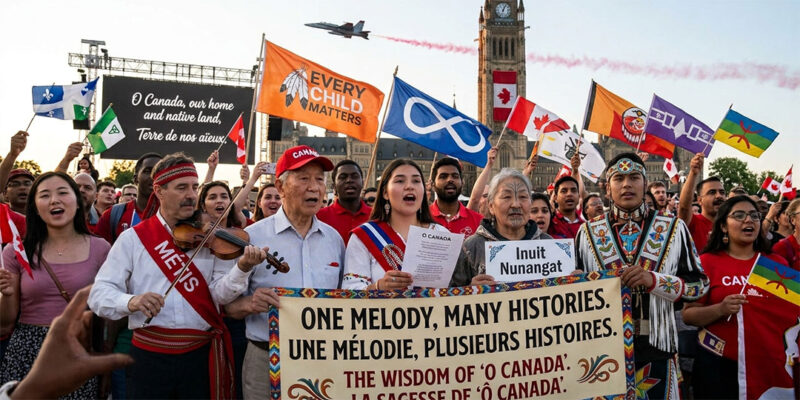
By Pin Qing
A nation is never merely a default product of physical geography; it is one of humanity’s most intricate and deliberate cultural constructs. While history grants a nation its past, and politics manages its present, it is the ongoing process of nation-building that ultimately decides its future. A truly mature state does not seek to erase internal differences to force a false harmony. Instead, it establishes a functional order within those differences, forging a shared identity out of multiplicity, continuously reinventing itself through the long stretch of history.
Canada is precisely such a nation—a collective project still very much in the making.
Every July 1st, as the familiar strains of O Canada echo simultaneously across the Rockies, along the St. Lawrence River, past the Atlantic coast, and over the Arctic tundra, millions sing the same melody. Yet, they do not all sing the same words, nor do they necessarily share the same historical memory.
In the English-speaking world, voices rise to celebrate “the True North strong and free.” Meanwhile, in French-speaking communities, the verses tell a different story—one of “ancestral lands” (terre de nos aïeux), carrying epic tales of “the sword and the cross” (il sait porter la croix). More recently, a growing number of public celebrations incorporate Indigenous languages alongside profound Land Acknowledgements. These acts serve as a vital reminder: long before the arrival of Anglo-French civilizations, this land already possessed its own stewards, its own languages, and its own deep-rooted history.
To hear the same melody carrying entirely different lyrics—and reflecting entirely different historical lineages within a single country—is a phenomenon nearly unparalleled on the global stage. Yet, this seeming paradox of “each singing their own tune” provides the perfect vantage point for understanding the wisdom of Canadian nation-building.
History reminds us that Canada’s national anthem was never a static, single-authored masterpiece. Rather, its evolution is a living mirror reflecting a century-long, ongoing history of a country defining its soul.