By
Dr. You-Zhi Tang | September 6, 2026
When people think of Canada, they often think of universal healthcare, high-quality education, a comprehensive social welfare system, and a multicultural and inclusive culture. Yet behind these visible institutions lies a force that is frequently overlooked but quietly sustains the entire society — volunteers. It is no exaggeration to say that without volunteer service, Canada would not be the Canada we know today.
The spirit of volunteering in Canada has a long history — one that is almost as old as Canada itself, and in fact predates the founding of the Confederation in 1867. Early Indigenous communities already practiced traditions of mutual aid and sharing. After European settlers arrived on this vast and harsh land, they too had to rely on mutual help among neighbours to survive the winters, build houses, and clear farmland. In those days, helping others was, in essence, also helping oneself.
From the nineteenth century onward, churches, charitable organisations, and various community groups gradually developed. Many hospitals, schools, libraries, and orphanages could not have been established without the participation and dedication of volunteers. During the two World Wars, millions of Canadians took part in all kinds of volunteer work: fundraising, nursing the wounded, caring for soldiers’ families, and supporting the front lines. Volunteer service became an important expression of national cohesion.
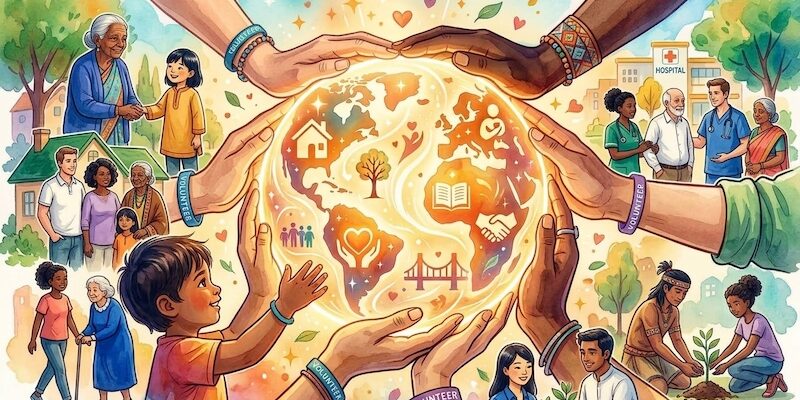
After the Second World War, Canada built a comprehensive social security system, yet the government did not replace volunteers. On the contrary, volunteers began to form a complementary relationship with government in serving society. Today, from hospitals to schools, from sporting events to nature reserves, from community festivals to food banks, from settling new immigrants to caring for the elderly — almost every field is alive with the presence of volunteers.
If we compare a modern nation to a table, it needs at least three sturdy legs to stand firmly. The first is government. Government makes laws, builds infrastructure, and provides public services. The second is business. Business creates wealth, drives innovation, and provides employment. The third is social organisations and volunteers. They connect people with one another and meet the needs that government cannot fully cover and that the market struggles to satisfy.
Government can build hospitals, but it cannot give every patient the companionship they need. Business can create wealth, but it cannot solve problems of loneliness, trust, and belonging purely through market mechanisms. Volunteers fill precisely this gap. They make society warmer and more resilient. They are one of the three essential pillars of a healthy society.
What volunteer service creates is not only value, but also trust. Economics measures GDP; businesses care about profit. Yet what truly determines whether a society is healthy includes a form of wealth that is far harder to quantify: trust between people. Sociologists call it “social capital.”
When people in a community are willing to help strangers, participate in public affairs, and contribute their time and abilities toward common goals, this trust continually accumulates. It cannot be written directly into a fiscal budget, yet it enables the whole society to function more efficiently and with greater cohesion.
Whenever natural disasters such as floods, wildfires, or blizzards strike, one invariably sees countless volunteers across Canada springing into action. They do so not for wages, but out of a sense of responsibility. It is precisely this spirit that gives society its most precious resilience in the face of hardship. And in fact, the greatest beneficiaries of volunteer service are often the volunteers themselves. Many people assume that volunteering is simply “helping others.” In reality, a growing body of research shows that volunteers themselves frequently benefit enormously.
First, it is health. Elderly people who engage in long-term volunteer work usually enjoy better mental well-being, lower levels of loneliness, and a more positive attitude towards life. Some studies have even found that people who continue volunteering tend to live slightly longer on average. Of course, this does not mean that volunteering itself has a life-extending effect; rather, the regular lifestyle, social connections, and sense of purpose together bring exert a positive influence on health.
Second, there is personal growth. Young people learn teamwork, communication, coordination, organisational skills, and leadership through volunteer activities — abilities that are difficult to acquire fully in the classroom. The author recently took part in an event related to a community youth volunteer project and witnessed the enthusiasm of the young volunteers, feeling deeply moved by their creativity and dedication.
Third, there is a sense of belonging. In modern society, people are increasingly prone to loneliness. Working together to accomplish something meaningful often builds genuine friendship more readily than ordinary social interactions. Moreover, many such voluntary efforts can have a positive impact on society to a certain degree.
Finally — and most importantly — there is meaning in life. Many retirees tell others that what they truly miss is not a salary, but waking up each day knowing they can still contribute something to society. Volunteer service allows this sense of value to continue.
It is worth noting that one important future direction for volunteer service may be knowledge-based volunteering. As Canada’s population ages, more and more experienced professionals are retiring. If their knowledge and experience retire with them, it would represent a huge social loss. Therefore, the author believes that knowledge-based volunteer service is a developing direction in Canadian volunteering that deserves attention:
- Engineers helping communities plan energy, environmental protection, and resource conservation projects;
- Scientists participating in public science outreach;
- Doctors conducting health education;
- Entrepreneurs mentoring young start-up founders;
- University professors tutoring students in research.
What they contribute is not merely time, but decades of accumulated professional knowledge, practical experience, and problem-solving ability. The long-term value of this knowledge transfer may exceed that of one-time material donations.
Moreover, volunteer service does not necessarily mean doing something earth-shattering. Anyone can become a ray of light in society.
- Chatting with an elderly person for companion;
- Helping a new immigrant become familiar with the community;
- Guiding a child through a science experiment;
- Taking part in a tree-planting activity;
- Maintaining order at a community festival;
- Or simply answering a stranger’s question with patience.
These seemingly ordinary small acts, when gathered together, form the most authentic foundation of a civilised society. Canada’s long-standing high levels of social trust and community cohesion owe much to volunteer service.
Some say a country’s development is measured by GDP. Others say a company’s success is measured by profit. The author prefers to believe that the true degree of a society’s civilisation is also measured by whether people are still willing to help others even when there is no reward. For a truly strong society is not merely one that possesses advanced technology, sound institutions, and a prosperous economy; it is one that possesses a group of people willing to contribute quietly for the common good.
Volunteer service may not change the entire world. But it can change a community, a school, a family, or even a single person’s life. And when countless such changes come together, they ultimately shape the society in which we all live. This, perhaps, is the spiritual wealth that Canada most deserves to cherish — and to pass on.